Why Overthinking is Destroying Your Decision-Making (And How to Fix It)?
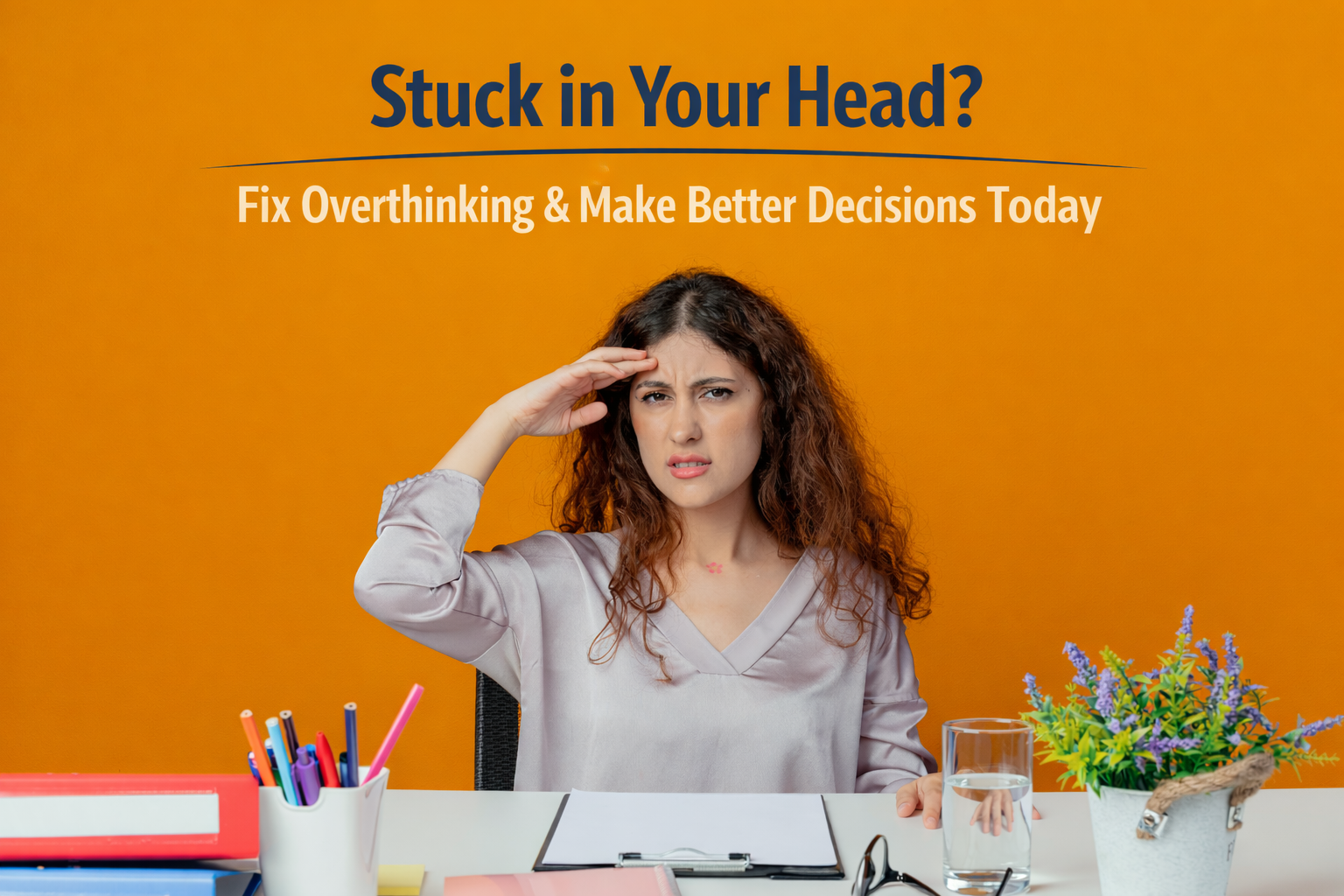
A simple decision sits in front of you, but rather than moving forward, your mind keeps digging even deeper. You replay your past experience, imagine future risks, and try to find the one “perfect” choice that truly guarantees a good outcome. However, the more you look for certainty, the more uncertain everything becomes.
That’s exactly how the overthinking problem silently takes control. It actually convinces you that more thinking will result in better decisions. In reality, it pulls you into decision anxiety, where every option seems complicated, almost every risk feels bigger, and taking action starts to be uncomfortable.
And, this is exactly where most people get stuck. It’s not because they lack clarity, but because they’re just waiting for complete clarity before even they act.
In this blog, we’ll explore what overthinking really is, why your mind keeps falling into this pattern, how it damages your decision-making, and most importantly, how to stop overthinking with some practical steps that you can smartly use in real life.
What is Overthinking?
Overthinking is actually when your mind keeps circling around the same thought or decision without even reaching a conclusion. It feels like you’re thinking deeply, but you’re actually stuck in a loop.
In simple terms, thinking helps you decide. While overthinking delays that decision.
- Thinking is completely clear and purposeful. You evaluate the overall situation and move forward.
- Overthinking is repetitive and painful. You keep doubting, rechecking, along with postponing action.
It happens when you stop looking for a reasonable answer and start chasing a perfect one.
For example, just imagine you’re considering a new job. A healthy way would be to analyze the position, compare alternatives, and then make decisions within a stipulated period of time. On the other hand, with overthinking, you start making questions at every possibility, what if something goes wrong, what if you regret it, what if something better comes later. Ultimately, you postpone or evade the decision.
The same thing occurs in other relationships where you overthink in conversations and cause confusion instead of clarity.
That’s the problem with overthinking. Really, it doesn’t lead to better decisions; it keeps you from making them.
Why Do We Overthink (Root Causes)?
Overthinking doesn’t just happen randomly. It typically comes from deeper mental patterns that are trying in order to protect you, but end up holding you back.
- Fear of Making the Wrong Decision: You are not making a choice; you are attempting to escape the regret. The stress of having to make the right choice makes each choice feel even more weight than it is.
- Need for Control: Your brain desires assurance. It keeps examining all angles continuously to feel in control even though some of the results are just unpredictable.
- Past Failures: The past error will always remain in the background. You go there again and again without even knowing it, and you make an attempt to ensure that you do not get the same result.
- Seeking Perfection: You are waiting until the right decision, the right moment and even the right outcome. However, that perfection is not always there and hence you are always left between such choices.
Fundamentally, though, overthinking is not about being confused. In addition to that, it is also about fear, control, as well as pressure to make no mistakes.
How Overthinking Affects Decision-Making?
Overthinking does not stay in your head; it directly impacts how you make decisions. Here’s how:
- Paralysis (no action)
You analyze so much that you end up doing nothing. Even simpler choices start to be overwhelmed.
- Delayed decisions
You keep waiting for even more clarity, more certainty, more “right timing”, and in the process, you miss the perfect moment to act.
- Increased anxiety
The constant loop of “what ifs” develops pressure. Every option you make starts to feel risky, which makes deciding even harder.
- Reduced confidence
The more you doubt your decision, the less you trust yourself. Over time, even minor choices feel totally uncertain.
Signs You’re an Overthinker
- Replaying past conversations
- Imagining worst-case scenarios
- Difficulty making small decisions
How to Stop Overthinking?
Overthinking won’t stop on its own. Here, you’ve to interrupt the pattern with clear actions. The goal is not to eliminate thinking, but to make it useful rather than endless.
Here’s how you can start doing that:
Step 1: Set decision deadlines
Initially, give your decision a time limit. Not everything needs several days of analysis. For small decisions, 10-30 minutes are enough. And, for bigger ones, set a clear deadline like 24 or even 24 hours.
When you set a deadline, it forces your brain on what matters instead of chasing every possible scenario.
Step 2: Limit your Options
Numerous alternatives create confusion. The more options you consider, the harder it becomes to decide.
So, reduce your choices to 2-3 solid options. This simple step can alone cut mental noise and make decision-making faster and clearer.
Step 3: Be Okay with Bad Decisions
There is no permanence in decisions and hardly any perfect decisions.
Rather than inquiring, What is the best choice?
All you need to do is just ask, What is a good enough choice that I can take action on right now?
So, this transition eliminates the general strain and assistance to move forward without waiting to know it.
Step 4: Do Little Steps in a Little Time
To be clear, one does not need to think more, but to do something.
Then just make your decision in small steps and take action on it.
When you do it, you have a real response in your mind, and it naturally minimizes overthinking.
Step 5: Work on what you can do.
One of the major causes of overthinking is an attempt to regulate the results that cannot be controlled.
Change the subject and pay attention to what you have in your hands, what you are doing, what you are preparing, what you are planning to do next. Then release outcomes like results, options or even uncertainties of the future.
Conclusion
Overthinking can feel like careful thinking. But actually, it drags you back to action. The more time you can postpone decisions, the more uncertainty and anxiety set in. This change now starts as you no longer seek the perfect answers but as you learn to believe in small, timely acts.
You do not have to have a full understanding to take action. Make one easy choice today, implement it, and leave it to work to give your mind the confidence it has been seeking.
Prakhar ke Parvachan
Powerful Thoughts, Motivational Parvachan & Life Lessons
Quick links
- Home
- About
- Why Prakhar
- Blog
Categories
- Feature
- Categories
- Love, Emotions & Healing