Introduction
Are you constantly bombarded by a torrent of thoughts? Do you find yourself replaying past conversations, predicting future catastrophes, or obsessing over minor details? If so, you’re not alone. Overthinking, often coupled with severe how to stop overthinking anxiety, is a pervasive issue that drains our energy, kills our productivity, and steals our peace. This comprehensive guide will equip you with actionable, science-backed strategies on how to stop overthinking forever and reclaim control of your mental landscape.
The Biology of the Busy Mind
To master how to stop overthinking forever, we first need to understand why it happens. Our brains are hardwired for survival. In prehistoric times, hyper-vigilance was necessary to avoid predators. Today, that same survival mechanism can get hijacked by modern stressors, causing us to overanalyze every potential threat, social interaction, or future event.
Why Overthinking and Anxiety Go Hand-in-Hand
The relentless mental chatter often fuels, and is fueled by, how to stop overthinking anxiety. When we overthink, we are essentially simulating potential negative scenarios. This simulation triggers the body’s ‘fight or flight’ response, releasing stress hormones like cortisol and adrenaline. This physical state of arousal then creates more mental urgency, trapping you in a self-perpetuating cycle of worry.
Taming the Daytime Thought Storm
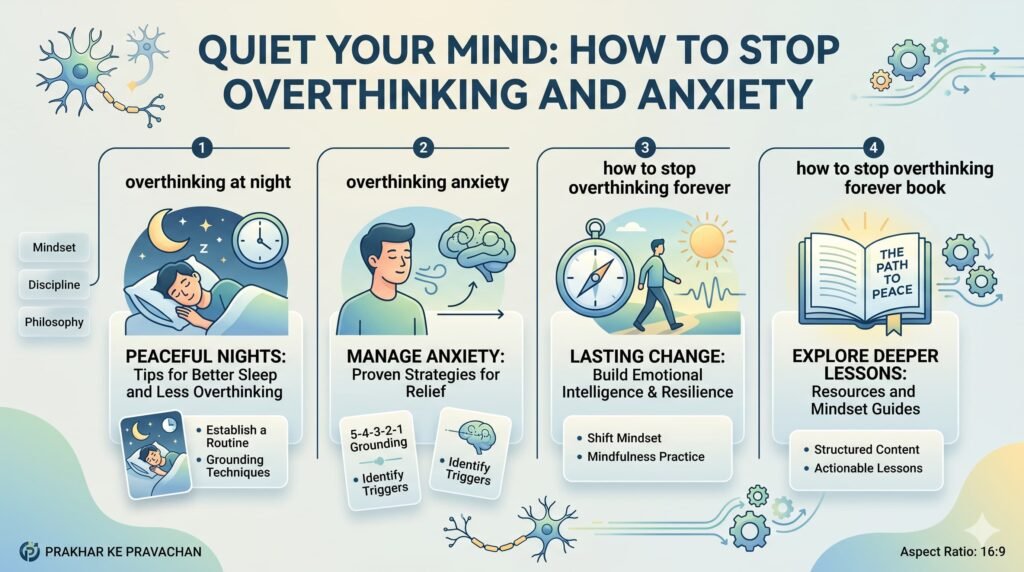
If you want to master how to stop overthinking, you need a mental toolkit to intervene when the thought storm begins.
1. Identify the ‘Analysis Paralysis’ and Shift to Action
Overthinking creates a state of ‘analysis paralysis,’ preventing you from making even simple decisions. This is often where how to stop overthinking anxiety is at its peak. The “5-Second Rule” (popularized by Mel Robbins) is a powerful intervention tool.
- The Strategy: When you feel stuck in a loop of indecision, count down backwards: “5-4-3-2-1.” When you reach 1, physically move to take the next small step.
- Why it Works: The countdown disrupts the cognitive loop of worry and engages the prefrontal cortex, the decision-making part of your brain. By shifting to action, you process the stress hormones that anxiety produces.
2. Challenge Irrational Thought Patterns
Overthinking relies on cognitive distortions—irrational thought patterns that don’t align with reality. Common patterns include catastrophizing (predicting the worst-case scenario) and mind reading (assuming you know what others think). Addressing these is a key life lesson for successful growth.
- The Strategy: Challenge your overthinking directly. Ask three questions:
- What is the objective evidence for this thought?
- What is the most likely outcome?
- If the worst happens, can I cope? (The answer is almost always yes).
Quieting the Mind Before Sleep
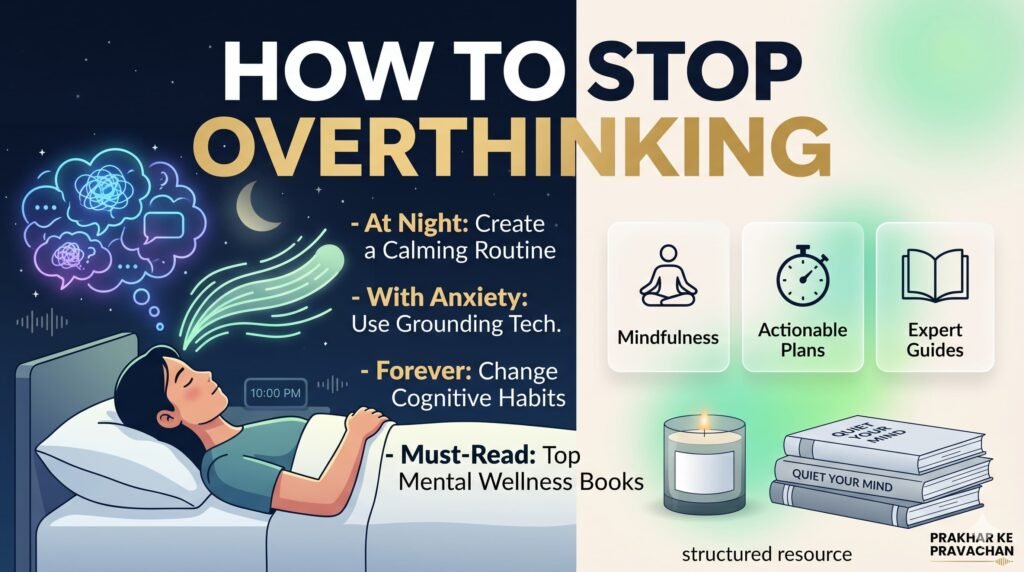
The quietness of the evening often amplifies mental noise, making how to stop overthinking at night a primary challenge for millions. The mechanism is simple: fewer distractions allow repressed worries to surface. Here are specific strategies for nighttime relief:
3. Implement grounding techniques and the 5-4-3-2-1 Method
When you’re trying to sleep, your body is still, but your mind is racing. Grounding techniques re-anchor you in your physical reality, pulling you out of the abstract worry loop.
- The Strategy: Use the 5-4-3-2-1 Method from your bed:
- 5: Name FIVE things you can see (even in the dark—shadows, a Dynamic visual wave representation of sound indicating audio content).
- 4: Name FOUR things you can touch (your blanket, your pillow, your own skin).
- 3: Name THREE things you can hear (the dynamic sound of your breath, the dynamic visual wave representation of distant traffic).
- 2: Name TWO things you can smell.
- 1: Name ONE thing you can taste.
4. Create a “Worry Window” to creating discipline
Trying to force yourself to stop worrying at night is like trying to push a wave back into the ocean—it won’t work. The Ironic Process Theory states that the more you try to suppress a thought, the more it persists. Instead, provide a structured system for it.
- The Strategy: Schedule a specific 15-minute “Worry Window” earlier in the day (e.g., 5:00 PM). If a worrying thought arises at 11:00 PM, tell yourself: “I will think about this at 5:00 PM tomorrow.” Then, re-focus on the present physical sensation.
Read also: Discipline vs Motivation: What Actually Works in Real Life?
Part 4: Building Long-Term Mental Discipline
Integrating structured practices into your life can permanently rewire your brain to be less reactive. This is fundamental to motivational parvachan (life lessons) and long-term successful growth.
5. Utilize mindfulness meditation to creates a structured resource
Mastering how to stop overthinking is not about emptying your mind; it is about practice observing a thought without reacting to it.
- The Strategy: Spend five minutes a day focusing only on your breath. When a thought appears (and it will), label it ‘thought’ and gently return your focus to your breath. Over time, this decreases the power anxiety-driven thoughts have over you.
6. Shifting Beyond Immediate Fixes: “How to Stop Overthinking Forever Book” Guide
While immediate techniques are vital, structured learning is essential for permanence. The concepts detailed in books like the widely cited “How to Stop Overthinking Forever Book” often focus on cognitive behavioral therapies (CBT) and acceptance and commitment therapies (ACT).
These structured resources provide the long-term blueprint required to permanently quiet the busy mind by changing how you fundamentally relate to uncertainty.
7. Optimize Physical Pillars: Sleep and Diet
High-performing individuals often sacrifice sleep and good nutrition, not realizing this is a direct trigger for severe how to stop overthinking anxiety.
- The Strategy:
- Sleep: Prioritize 7-9 hours of consistent sleep. A sleep-deprived brain is hyper-reactive and less capable of rational thought.
- Diet: Stable blood sugar is crucial. Blood sugar crashes can mimic a panic attack, sparking a wave of overthinking. Avoid excessive caffeine, which directly stimulates anxiety.
Read also: Ego vs Confidence: The Fine Line Most People Do Not Understand
Conclusion: A Structured Resource for Mental Well-being
The strategies outlined here—from grounding techniques for anxiety relief to shifting from analysis to action—are not a quick fix. Mastering how to stop overthinking is a continuous process of changing cognitive habits. By integrating these structured systems into your life, you build the resilience needed to quiet the mental chatter.
Reclaiming your peace of mind is possible, and it starts with the single decision to change how you react to your thoughts. This website is a dedicated, structured resource for your continuous mental wellness and successful growth.
For more detailed insights, you can explore established mental health organizations like the APA.
Frequently Asked Questions?
1. What is the fastest way to stop overthinking anxiety?
The fastest way to interrupt a wave of overthinking anxiety is to use physical grounding techniques, such as the 5-4-3-2-1 method. By shifting your focus entirely to your immediate sensory inputs—identifying specific things you can see, touch, hear, smell, and taste—you physically force your brain out of the abstract worry loop and anchor your nervous system back into the present moment.
2. Why does overthinking get worse at night?
Overthinking often peaks at night because your brain experiences a sudden drop in external stimuli. During the day, work, social interactions, and daily tasks distract your mind. When you lie down to sleep in a quiet room, those distractions disappear, creating a mental vacuum where suppressed worries, stress, and anxiety naturally surface and loop continuously.
3. Can overthinking cause physical symptoms of anxiety?
Yes, chronic overthinking directly triggers physical anxiety symptoms. When you ruminate on negative scenarios, your brain cannot distinguish between a real threat and an imagined one. This activates your sympathetic nervous system, releasing stress hormones like cortisol and adrenaline, which manifest physically as a racing heart, muscle tension, shallow breathing, and insomnia.
4. How can I stop overthinking in a relationship?
To stop overthinking in relationships, you must actively challenge cognitive distortions like “mind reading” (assuming you know what your partner thinks) and “catastrophizing” (expecting the worst). Instead of letting anxious loops dictate your mood, practice direct and open communication with your partner to verify facts rather than relying on internal assumptions.
5. Is overthinking a mental illness?
Overthinking itself is not classified as a clinical mental illness; rather, it is a cognitive habit or defense mechanism. However, persistent, uncontrollable overthinking (rumination) is a primary symptom of underlying mental health conditions, such as Generalized Anxiety Disorder (GAD), depression, and obsessive-compulsive tendencies.
[…] If you are looking for effective tips to stop overthinking naturally and improve your mental well-being, read this detailed article: How to Stop Overthinking and Reduce Anxiety […]
[…] How to Stop Overthinking, Reduce Anxiety, and Sleep Peacefully: The… […]