How the Butterfly’s Metamorphosis Teaches Us to Embrace Change and Transformation
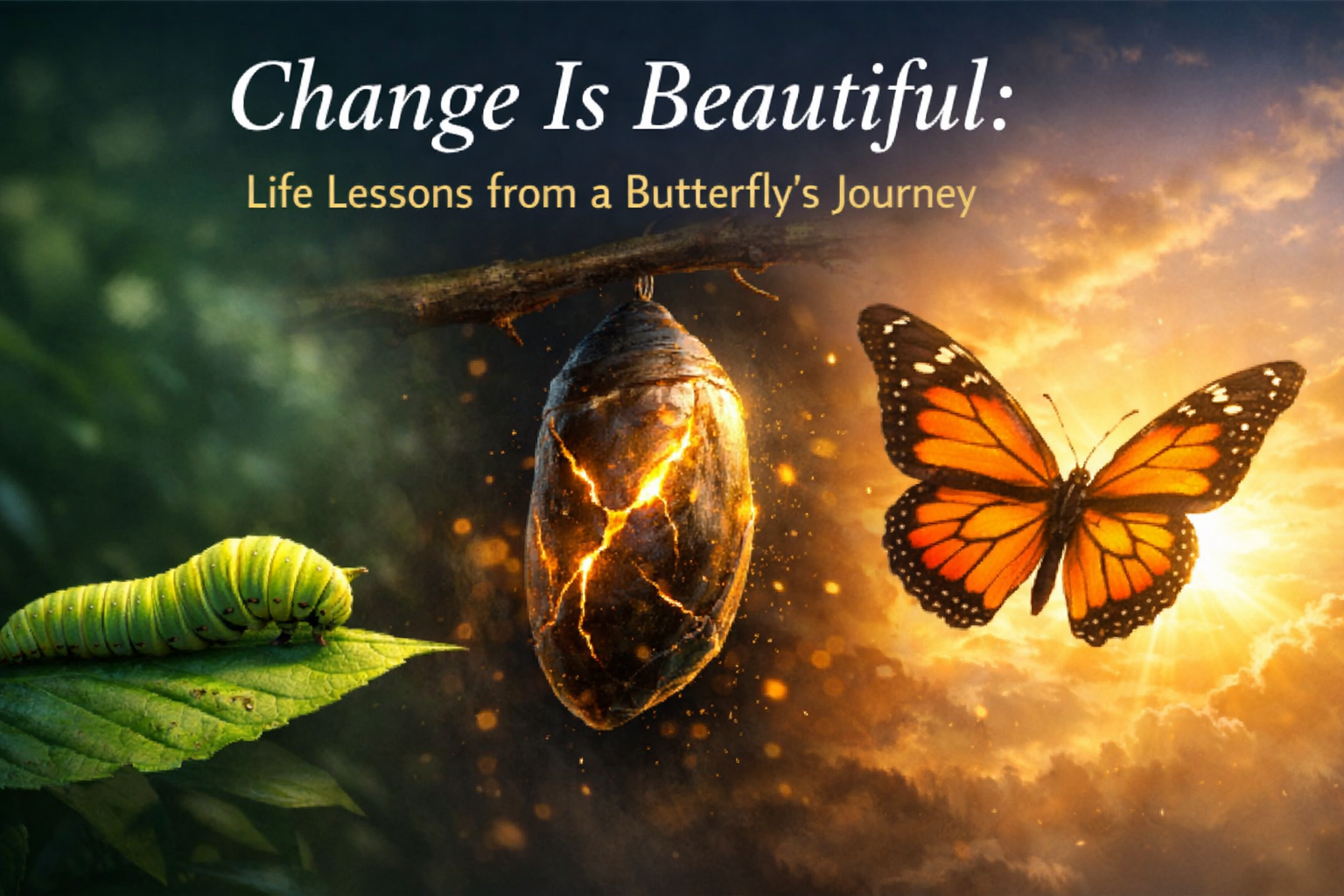
Change makes us uneasy. While we can see that it is a great learning experience, it will frequently feel uncomfortable because you have to move into the unknown by letting go of what you now possess and putting your trust in the unknown. For many of us, these are losses, not necessarily a step forward.
And so, we resist.
We hold on to routines, identities, relationships, and beliefs. After all, they are comfortable, not always because they benefit us. Even when familiarity subtly restricts us, it feels secure. Peace, like in nature, often does not provide hope throughout one’s adventure. Peace can push, prod, or even shove you into making adjustments. The talk highlights how nature is always changing. It often appears to be much greater than it is. But it does take close attention to grasp.
One of the best instances of this transition is a butterfly. How come? This transformation shows that adopting new identities requires a fundamental transformation of who you are. Like butterflies, we are always developing. The entire procedure demonstrates how humans must embrace change as a necessary part of existence.
Stage 1: is referred to as the “Caterpillar Phase”. It has its own Drawbacks and Comfort.
At the start, there existed an insect that ate food and progressed at an even speed without any sense of speed/urgency or knowledge of its possible fate. It lives simply. The insect had everything it could possibly want.
This is a lot like how people live.
We build routines. We take solace in familiarity. Roles, routines, and safe spaces are how we define ourselves. Additionally, this comfort eventually starts to feel stable. But there’s a subtle trick here: comfort and progress are not the same.
The comfort zone can subtly become a prison over time.
Many of us continue to think like caterpillars even when we have the opportunity to change. Because it scares people to move forward. They continue to labor at uninteresting jobs or hang out with uninspired people. Additionally, they continue to follow unproductive habits.
Changing one’s identity is frightening since we never know what or who we will become if we are not who we are today.
But you won’t make any progress until you begin to feel uncomfortable and just stay in your comfort zone. There must be more than this when something murmurs within you.
That murmur is the start of change, not a sign of discontent.
Stage 2: Internal Work and Seclusion: The Cocoon Phase
The most misunderstood stage is the cocoon, which comes next.
It appears as though nothing is going on from the outside. There are no indications of change, no movement, and no discernible advancement. But mostly everything keeps changing on the inside.
Instead of just resting or sleeping, the caterpillar is decomposing. This is when struggle-based transformation really starts.
This period of life can be characterised by emotional pain, confusion, or isolation. This is often referred to as “the time things fall apart before they can be put back together again”. This is a transition period where new identities are still being formed, while at the same time, old identities are disappearing.
It can resemble getting lost. However, this is not a failure. Restructuring is what it is.
Solitude is frequently necessary for growth not because we are designed to be alone, but rather because we need room to hear ourselves properly. Weaponizing silence transforms it into a social advantage. Silencing outside stimuli forces us to face our fears, values, and beliefs.
It is recommended that we let go at this point.
Abandon the habits that once defined your identity as an individual. Get rid of old ways of thinking that you have grown beyond. Let go of the person you once were if your old identity no longer serves you as you continue to develop into new versions of yourself.
And that process is rarely comfortable. This time may feel ambiguous psychologically. You could doubt your choices, your course, or even who you are. However, in progress, what appears to be uncertainty is frequently clarity.
The cocoon is a location of intense inward effort rather than a place of stagnation. In actuality, metamorphosis is always unseen before it manifests itself.
The Struggle to Break the Cocoon
During the journey of a butterfly, the fights it makes to leave its cocoon could teach us lessons about our own struggles.
You.Better.Break.Out!!! Why? To become a butterfly! And you must use every ounce of strength you have to push against the edges of your cocoon to accomplish this. (Yes! Your shape can be changed!)
Butterflies do not have flying muscles until they develop them inside the chrysalis stage of their life cycle. If someone were to assist a butterfly out of its cocoon with a pair of scissors, they may not fully develop their flying muscles and increase the chance of dying before being able to fly.
Why?
Because its wings get strengthened by the effort. It will never learn to fly without that opposition.
At this moment, many people misunderstand the relevance of growth within the context of change. Usually, we want to avoid experiencing pain, will do things to avoid working through difficult circumstances, and often try to bypass or finish any degree of discomfort as rapidly as possible.
Change requires challenges, not the other way around. For instance, a number of life’s obstacles, such as losing your job, having an emotional breakdown, coping with loss, and/or going through grief, may prevent you from growing, but when they are encountered, they will enable you to reach your maximum potential because they will test your ability to adapt.
You get stronger when you resist because pain can mold you in various ways.
Even while it’s normal to crave relief, running away from suffering too soon might prevent you from gaining the strength you need. Not all struggles should be avoided. Some are designed to mold you.
The Butterfly Phase – Freedom and New Identity
And lastly, the appearance.
Instead of emerging as a better caterpillar, the butterfly is entirely transformed. Though it is no longer defined by it, it nevertheless has the recollection of its former existence.
This is the real expression of transformation and self-improvement.
The objective is not to become someone else. It’s about growing into the person you were meant to be.
With transformation comes a quiet confidence. Not loud or performative, but grounded. You begin to see life differently. Your perspective expands. What was previously overpowering now seems doable. What used to define you no longer rules you.
This stage is characterized by emotional maturity—a deeper comprehension of oneself, one’s actions, and one’s purpose.
And maybe the most exquisite aspect?
Freedom.
Internal and external freedoms are equally important. Being free from your ideologies is one thing; however, making decisions out of fear is quite another. You must also be released from the need to uphold your former identity. If someone uses a butterfly as an example, they won’t regret being a caterpillar. It simply outgrows it.
Why Most People Resist Change
Despite how natural transformation is, most people resist it.
Why? Because change challenges identity.
Everyone has that feeling of fear about how others will view you when you try something different and about the unknown (What happens if I try it and it doesn’t work?).
There’s attachment—This is who I’ve always been.
Social conditioning is another. We are frequently taught to prioritize predictability over change and stability above development. to maintain consistency, even if it is restrictive.
In the majority of instances, it will cause you greater pain to stay the same than to take action and change yourself.
While the majority of resistance you feel to getting to your goals is from the fear of the unknown and not your own lack of ability to reach your goal, fear is just as natural an emotion; however, it can be a very unreliable source of information.
How to Embrace Change in Your Life
There is no assurance that you won’t feel uncomfortable if you accept change. It implies that you acquire the ability to overcome it.
To begin, acknowledge that pain does not indicate a problem. It frequently indicates that you are maturing. It feels heavier the more you oppose it. As you accept it more, it teaches you more.
Give yourself time to think. Growth requires a ton of awareness of your internal processes. Hence, one must be careful to focus especially on the changes you will experience internally. You can write, find a quiet place, or spend some time away from distractions to truly contemplate.
Give up your former identity. One of the most challenging aspects may be this. Because it seems comfortable, we cling to our former selves. But growth often asks you to release that version of yourself.
Trust your internal evolution. If you are missing all the answers, that’s okay. There is no set route for transformation; it happens as you go.
Above all, quit comparing your trip. Everybody’s chronology is different. Changes happen fast sometimes, slow at other times. The rate at which it happens is less important than the intention behind making those changes.
Struggle-induced transformation should be welcomed rather than dreaded.
Conclusion
If you’re in a difficult phase right now, it’s easy to believe that you’re stuck. That nothing is moving. Things are falling apart.
What if, however, this is your cocoon? What if your suffering is a sign of becoming rather than failure? You’re not standing still. You are evolving. Throughout every production of uncertainty, through times when you feel solitary, and through difficulties you encounter, alter some aspect of yourself, even though they may not be apparent yet.
Ultimately, you’ll discover that the moment when you were most afraid has permanently changed you. During the transitory period, everything has changed, although you might not notice the changes at the moment.
The hardest changes are the ones that happen within—unseen, but undeniable.
Prakhar ke Parvachan
Powerful Thoughts, Motivational Parvachan & Life Lessons
Quick links
- Home
- About
- Why Prakhar
- Blog
Categories
- Feature
- Categories
- Love, Emotions & Healing