The Power of Self-Control in a World Full of Distractions
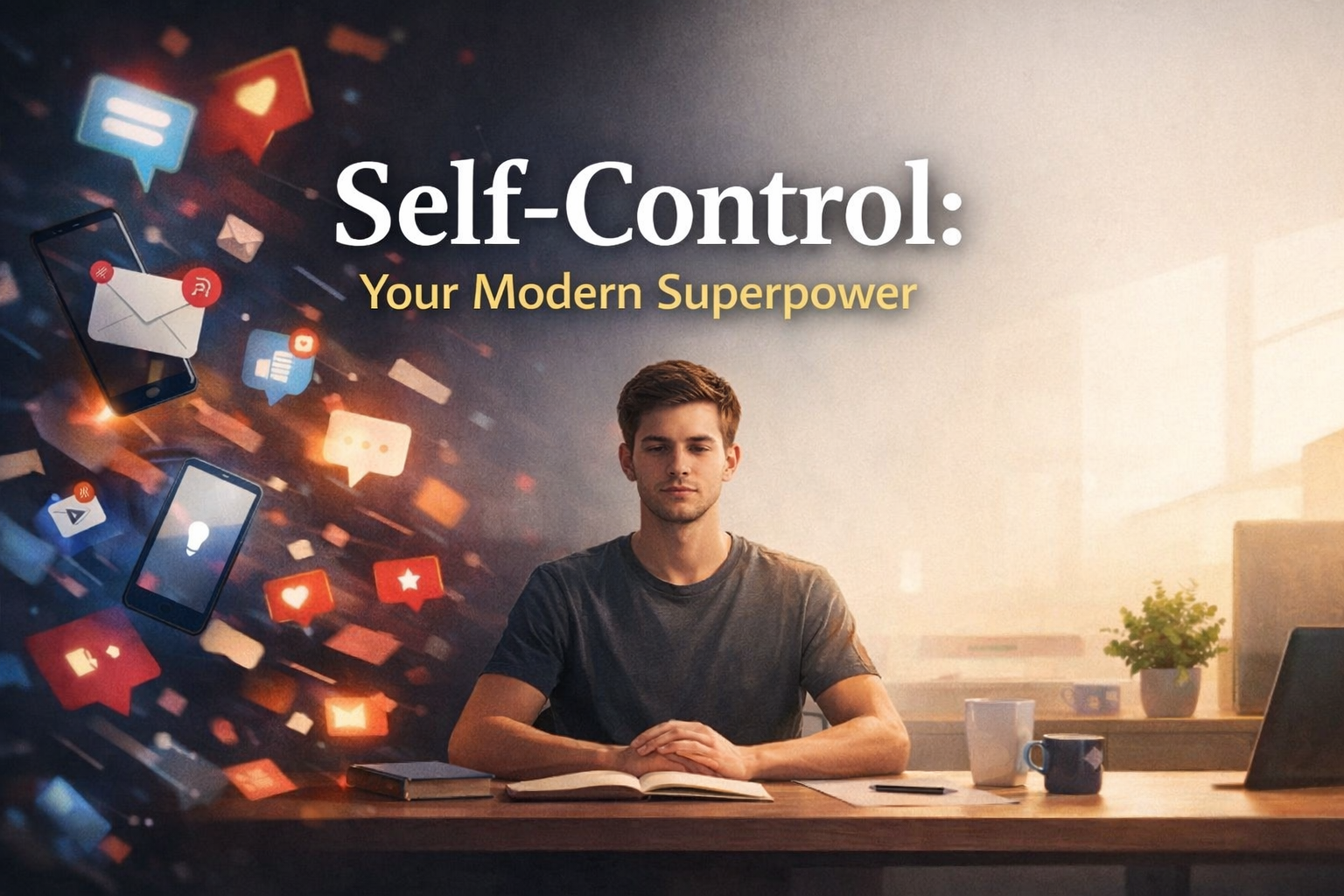
We are unaware of just how much we are impacted by the distractions that can be found today — the distractions of our phones and the constant barrage of messages, alerts, videos, and thousands of things available to us when we pull up our device have most likely made your attention run in multiple directions and prevents you from being able to concentrate on what you would like to concentrate on.
While you may have been trying very hard to stay focused, the earlier-mentioned things are not contributing to your ability to succeed. The problem is that these distractions have been competing for your attention at a faster speed, an easier way, and in a more exciting manner than they ever have.
As a result, in order to succeed in today’s society, you must not only possess intelligence and ability but also be recognized for these things in order to gain success; we cannot see that people who have great ability, motivation, and potential will demonstrate any signs of success.
Right now, self-control can be seen for what it’s worth: the ability to control your feelings, impulses, and actions has quietly evolved into your own personal superpower in a world that was created to keep you from focusing on anything. It’s people with self-control who will progress more than any other group of people.
What Is Self-Control Really?
Sometimes people misunderstand self-control as being overly strict or depriving oneself of all enjoyable experiences. However, in practice, it has little to do with limitations.
The capacity to make deliberate decisions rather than behave instinctively is known as self-control. It’s the little interval between what you truly decide to do and what you feel like doing. We already know what is right most of the time. The issue isn’t about not having information; it’s not being able to consistently implement what you know.
Self-Control has three primary components:
Emotions – controlling your emotional response instead of letting your emotional response control your behaviour is referred to as emotional regulation.
Discipline – allowing distractions to detract from what you find valuable requires discipline as a reminder of those things.
Awareness – awareness enables you to resist acting contrary to your long-term goals through your daily practises.
You may exhibit self-control by being able to turn down the impulse to look at your phone while maintaining calmness and respect for those you debate with.
Self-discipline is best understood by referring to the fact that you have the power to choose long-term benefits over short-term pleasures.
It doesn’t make life restrictive—it actually gives you direction.
Why Distraction Is the New Addiction
Distractions are no longer random or happenstance. Rather, they have all been intentionally developed in order to stop you from losing interest in that piece of programming, notification, or scrolling for as long as possible.
Each time you check your phone or look at the news on a social networking site, your brain receives a small reward. As a result, you go in a cycle of returning to these apps when you really do not need to.
This becomes a habit over time.
In particular, social media is crucial to this. It makes comparisons in addition to providing entertainment. Your personal growth may seem slower or less important since you are constantly exposed to information about the lives, accomplishments, and highlights of others.
You may not notice the effects of this ongoing exposure right away:
- Your ability to focus decreases because your mind gets used to quick stimulation
- Your thoughts feel scattered because you’re always consuming something
- Your confidence can drop due to comparison and unrealistic standards
- Your productivity suffers because deep work becomes harder
For this reason, distraction is sometimes likened to addiction. Although it doesn’t feel bad right away, it gradually impairs your capacity to remain concentrated and in the present.
Furthermore, it is hard to construct anything significant without attention.
The Hidden Cost of Lack of Self-Control
Seldom does a loss of self-control result in immediate harm. Instead, it’s shown through little decisions that are made repeatedly and over time will have a cumulative effect on your life.
When you often choose the comfort of not having to struggle (as opposed to making the effort) and you find it hard to finish the essential tasks that need doing, this can lead to emotional responses, even though you should be patient. Even though each of these choices may appear unconnected and not worth much in isolation, they accumulate on one another over time.
The effects may have an impact on several aspects of life:
- Relationships may suffer when reactions replace understanding
- Inconsistency and a lack of concentration cause career advancement to slow down.
- Impulsive choices have an influence on financial stability.
- Health declines when discipline is replaced by convenience.
One of the biggest effects of not respecting your gut feelings may be a disconnect from yourself.
When you fail enough times to validate your gut instinct, you begin questioning yourself as to whether or not you’re capable or simply feel more accomplished than you are. There is nothing worse than seeing the conflict between your actions and purposes constantly drain you.
At the same time, it will subconsciously impact both your performance and self-esteem/confidence.
Self-Control Creates Inner Strength
Even though we might not view them as having great benefits at first, self-control is very important for growth. People develop self-control through developing small commitments, such as having a plan to stick to and holding themselves accountable for completing their work. People can better enjoy life’s smaller moments by exercising regularly.
Self-discipline positively impacts your decision-making abilities and will continue to help you for years to come. Being self-disciplined makes you learn how to look at all parts of a possible option before making a choice; with a result of having less conflict with your emotions connected to making decisions. As an outcome of this practice, you will create less emotional stress when you are making a decision and, under pressure or stress, are less likely to react with an impulse or emotional reaction.
The effect of developing self-discipline is that many people report an increase in daily productivity through their use of self-discipline. True resilience comes from controlling your thoughts and emotions, compared to previous notions of development coming from what you accomplish externally. One way people develop a sense of internal strength and stability is through developing self-control of their behaviours.
You really have a lot of resistance to outside influences and distractions once you have mastered yourself. That is self-discipline’s true strength.
Practical Techniques for Gaining Self-Control
You don’t need an entire lifestyle change to create self-discipline, but developing even some level of self-discipline will set you down a path towards developing your self-control ability. Making a complete change in lifestyle is not required; instead, the way you can develop your own self-control is by starting off with small, incremental changes to your regular daily routines for the purpose of building more effective self-management skills over time.
Here are a few more methods for cultivating self-control:
- Make a conscious effort to hold off on using your phone or checking on anything else you need to do for at least 10 minutes. This simple pause weakens impulsive behavior.
- Establishing block periods for Social Media Distractions can help you to minimize distractions in your environment and give you more time to concentrate on your tasks.
- Using the same period of the day to take “breaks” from products, such as during the day you may not text, will also contribute to your ability to be focused.
- Establishing firm boundaries in how much time you will spend using devices, working, or being engaged with technology during a given period of time each day is essential to your success each day. Intentionality reduces mindless behavior.
- When you receive information or experience a problem working with someone else, it is a good practice to take at least one minute before responding. The purpose of this is to give the other individual an opportunity to also contemplate their reaction before acting impulsively.
A set daily schedule will allow for maximum production and efficiency with the various tasks you need to complete, and assist you in developing a habit of self-discipline. Last, but not least, it is also important that you complete all of your homework assignments every day.
While developing your self-disciplined habit through a routine or schedule helps you, it is equally important that you understand what is causing you to be distracted from developing this discipline.
Once you have identified what those types of distractions are, you will be able to determine how to control and manage the distractions you face and establish a consistent model of how to control the many disruptions that come up on a day-to-day basis, while at the same time developing your ability to do multiple things at once.
Control yourself/Growth Spiritual.
Success and productivity are only two aspects of self-control. Additionally, it has a deeper, internal impact. You create space between sensation and action when you start paying attention to your ideas and impulses rather than acting upon them right away. You get clarity in that area.
You start to realize that not every thought and emotion needs to be expressed at this time. Calm and equilibrium are brought about by this understanding. Controlling your inner world is really what self-control is all about. It allows you to live consciously rather than reacting automatically to everything around you.
Genuine freedom comes from having the ability to deliberately choose what to do rather than doing whatever you desire.
Conclusion
Distraction is simple. It is ubiquitous and continuously pulls you in many ways without taking any effort on your part. Conversely, discipline is uncommon. It takes dedication and perseverance to become self-aware, comprehend what has to be done, and have the guts to take action even when it is uncomfortable.
The benefits of your activities will also be great.
You cease feeling disorganized when you learn self-control. You gain stability, attention, and decision-making control. By building a life that is more reflective of the goals you wish to accomplish rather than the desires you have. If you have self-regulation, you can achieve your goals, and you will be accountable for yourself. Being able to select what type of individual you want to be, where you wish to reside, etc., are the important facets of your personal life as an individual.
As a simple truth, it all comes down to this:
You can either control your thoughts, or they will control you!
Prakhar ke Pravachan
Powerful Thoughts, Motivational Pravachan & Life Lessons
Quick links
- Home
- About
- Why Prakhar
- Blog
Categories
- Feature
- Categories
- Love, Emotions & Healing
Disclaimer: This website is an independent informational platform and is not officially affiliated with, endorsed, or owned by Prakhar Gupta or his management. All trademarks belong to their respective owners. This domain name is independently registered and may be available for acquisition. For domain purchase inquiries or content removal requests, please contact us directly.
© 2026 Prakhar ke Pravachan — Motivational Thoughts | Life Lessons | Powerful Quotes. All Rights Reserved.
[…] Also Read: The Power of Self-Control in a World Full of Distractions […]