Ancient Civilizations & Archaeology: Exploring Lost Human History
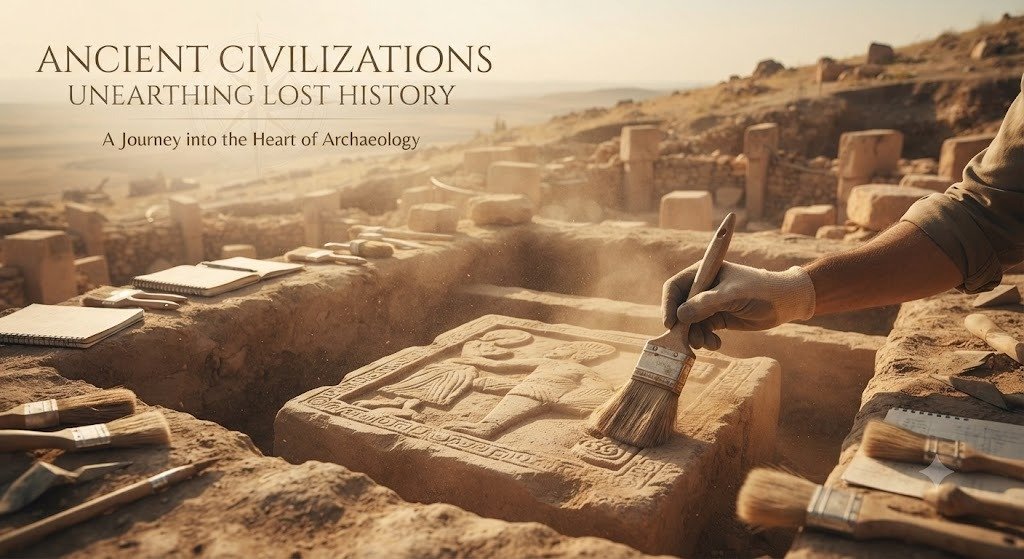
Human history stretches back millions of years, but only a small fraction of it is preserved through archaeological evidence. Every excavation, ancient inscription, and buried city offers valuable insights into how civilizations emerged, evolved, and shaped the modern world. From the world’s earliest cities in Mesopotamia to the mysterious stone enclosures of Göbekli Tepe, archaeology continues to uncover stories that remained hidden for thousands of years.
In this article, we’ll explore the origins of ancient civilizations, the discoveries that transformed our understanding of history, and the enduring mysteries researchers are still working to solve.
What Is an Ancient Civilization?
An ancient civilization is a society that developed organized communities with agriculture, permanent settlements, governance, trade, and cultural achievements. While each civilization evolved in its own way, most shared several defining characteristics:
- Permanent cities and settlements
- Organized systems of government
- Agricultural production
- Extensive trade networks
- Writing or other methods of record-keeping
- Religious and cultural traditions
- Technological innovation
These developments marked humanity’s transition from small hunter-gatherer groups to complex societies capable of building cities, monuments, and enduring institutions.
How Human Civilization Began
For most of human history, people lived as hunter-gatherers. Around 10,000 BCE, the Neolithic Revolution transformed human life as communities began cultivating crops and domesticating animals.
Agriculture enabled people to settle in one place, produce food surpluses, and support larger populations. Over time, villages expanded into towns, and towns eventually developed into some of the world’s earliest civilizations.
This transformation also encouraged specialization. Rather than everyone producing food, some people became builders, artisans, traders, priests, administrators, or soldiers, allowing societies to become increasingly complex and interconnected.
The World’s Earliest Civilizations
Mesopotamia: The Cradle of Civilization
Located between the Tigris and Euphrates Rivers in present-day Iraq, Mesopotamia is widely regarded as one of the first centers of civilization.
Its achievements include:
- The invention of cuneiform writing
- Early legal systems
- Irrigation-based agriculture
- Urban planning
- The wheel
- Advanced mathematics and astronomy
Cities such as Uruk and Ur became major political, economic, and cultural centers, influencing neighboring regions for centuries.
Ancient Egypt
Ancient Egypt flourished along the Nile River and became renowned for its monumental architecture, sophisticated engineering, and enduring cultural legacy.
The civilization is known for:
- The Great Pyramids
- Hieroglyphic writing
- Advances in medicine
- Solar and lunar calendar systems
- Monumental temples
- Centralized rule under the pharaohs
Many of Egypt’s monuments remain among the best-preserved archaeological sites in the world.
Indus Valley Civilization
The Indus Valley Civilization developed across present-day Pakistan and northwestern India between approximately 2600 and 1900 BCE.
Its cities demonstrated remarkable urban planning, including:
- Grid-based street layouts
- Advanced underground drainage systems
- Standardized baked-brick construction
- Public baths
- Long-distance trade networks
Unlike many contemporary civilizations, archaeologists have found little evidence of grand palaces or monumental royal tombs. One of its greatest mysteries is the Indus script, which remains undeciphered despite decades of research.
Ancient China
Early Chinese civilization emerged along the Yellow River, with the Shang Dynasty providing the earliest confirmed archaeological evidence of a complex state.
Important achievements include:
- Bronze metallurgy
- Oracle bone inscriptions
- Early Chinese writing
- Organized kingdoms and royal courts
These innovations laid the foundation for one of the world’s longest continuous civilizations.
Mesoamerican Civilizations
Across present-day Mexico and Central America, civilizations such as the Olmec, Maya, and later the Aztecs made extraordinary contributions to science, mathematics, and culture.
They developed:
- Highly accurate calendar systems
- Advanced astronomical observations
- Monumental pyramids and ceremonial centers
- Complex writing systems
- Sophisticated mathematics, including the use of zero by the Maya
Modern LiDAR technology continues to reveal thousands of previously unknown settlements hidden beneath dense tropical forests, reshaping our understanding of these civilizations.
Göbekli Tepe: The Discovery That Changed History
One of archaeology’s most remarkable discoveries is Göbekli Tepe in southeastern Türkiye.
Dating to around 9600 BCE, it is more than 11,000 years old, making it significantly older than both Stonehenge and the Egyptian pyramids.
The site features enormous carved stone pillars arranged in circular enclosures and decorated with intricate animal reliefs.
For decades, historians believed agriculture had to develop before large monuments could be built. Göbekli Tepe challenged this assumption by demonstrating that large communities of hunter-gatherers were capable of organizing massive construction projects long before farming became widespread.
Although researchers continue to debate its exact purpose, the site has fundamentally reshaped our understanding of early human societies.
How Archaeology Reveals the Past
Modern archaeology involves far more than excavating artifacts. Researchers combine multiple scientific disciplines and advanced technologies to reconstruct ancient history with remarkable precision.
Some of the most important methods include:
- Radiocarbon dating to estimate the age of organic materials
- Ancient DNA analysis to study past populations
- LiDAR scanning to detect hidden cities beneath forests
- Ground-penetrating radar to locate buried structures
- Satellite imagery for landscape analysis
- Isotope analysis to understand diet, migration, and environmental conditions
- 3D digital reconstruction of archaeological sites and artifacts
Together, these tools continue to reveal discoveries that would have been impossible only a few decades ago.
Ancient Civilizations: Facts vs. Popular Myths
Ancient history often inspires extraordinary claims, but archaeology relies on verifiable physical evidence rather than speculation.
Here are some common misconceptions:
Myth: Atlantis has been discovered.
Fact: No verified archaeological evidence confirms that Atlantis existed as a historical civilization.
Myth: Aliens built the Egyptian pyramids.
Fact: Extensive archaeological research demonstrates that skilled Egyptian laborers built the pyramids using sophisticated engineering, organization, and construction techniques.
Myth: The Indus script has been translated.
Fact: The script remains undeciphered, making the civilization one of history’s greatest archaeological mysteries.
Myth: Ancient people lacked scientific knowledge.
Fact: Many ancient civilizations mastered engineering, mathematics, astronomy, medicine, architecture, and urban planning long before the development of modern technology.
Why Did Ancient Civilizations Collapse?
Most civilizations did not disappear suddenly. Instead, historians believe that multiple factors often combined over long periods to weaken societies.
Common causes include:
- Climate change
- Environmental degradation
- Political instability
- Warfare
- Disease outbreaks
- Economic decline
- Population migration
In many cases, societies adapted, merged with neighboring cultures, or gradually evolved into new civilizations rather than disappearing entirely.
Questions That Still Puzzle Archaeologists
Despite centuries of research, many mysteries remain unsolved.
Researchers continue to investigate questions such as:
- What does the Indus script actually say?
- Why was Göbekli Tepe constructed?
- How interconnected were early civilizations through trade and cultural exchange?
- How many ancient cities remain hidden beneath forests, deserts, glaciers, or the ocean?
- What role did climate change play in the rise and decline of early societies?
Future discoveries may once again reshape our understanding of human history.
Why Ancient Civilizations Still Matter Today
Ancient civilizations continue to influence modern society in countless ways. Systems of writing, law, engineering, agriculture, architecture, mathematics, and governance all trace their origins to early human societies.
Archaeology helps us understand not only where we came from but also how civilizations responded to challenges such as environmental change, migration, conflict, and technological innovation. Every new discovery adds another piece to humanity’s shared story.
read also-The Art of Articulation: How to Speak Like Prakhar Gupta
Final Thoughts
The study of ancient civilizations is an ongoing journey rather than a completed chapter of history. From Mesopotamia and Egypt to the Indus Valley, Ancient China, and the Maya, every civilization contributed ideas and innovations that continue to shape the modern world.
Meanwhile, discoveries such as Göbekli Tepe remind us that history is constantly evolving. As archaeologists uncover new evidence using advanced technologies including LiDAR, satellite imagery, ancient DNA analysis, and remote sensing our understanding of the past becomes richer, more detailed, and sometimes completely transformed.
Perhaps archaeology’s greatest lesson is that there is still much left to discover. Beneath deserts, forests, mountains, glaciers, and even the ocean floor, countless chapters of human history remain hidden, waiting to be revealed.
Prakhar ke Pravachan
Powerful Thoughts, Motivational Pravachan & Life Lessons
Quick links
- Home
- About
- Why Prakhar
- Blog
Categories
- Feature
- Categories
- Love, Emotions & Healing
Disclaimer: This website is an independent informational platform and is not officially affiliated with, endorsed, or owned by Prakhar Gupta or his management. All trademarks belong to their respective owners. This domain name is independently registered and may be available for acquisition. For domain purchase inquiries or content removal requests, please contact us directly.
© 2026 Prakhar ke Pravachan — Motivational Thoughts | Life Lessons | Powerful Quotes. All Rights Reserved.